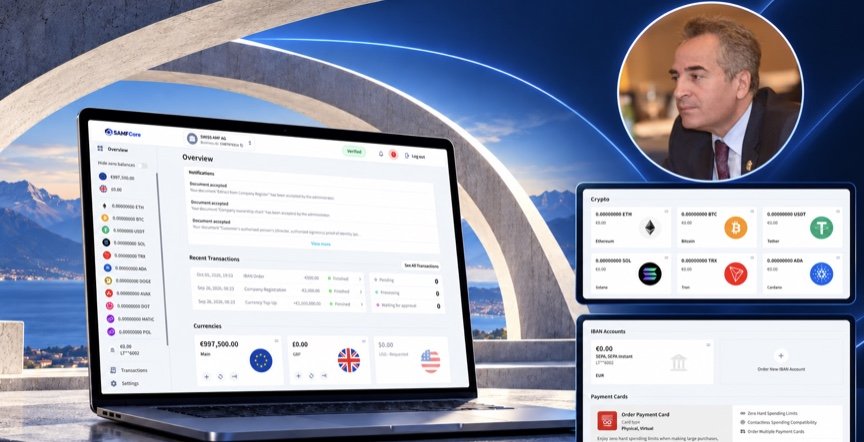
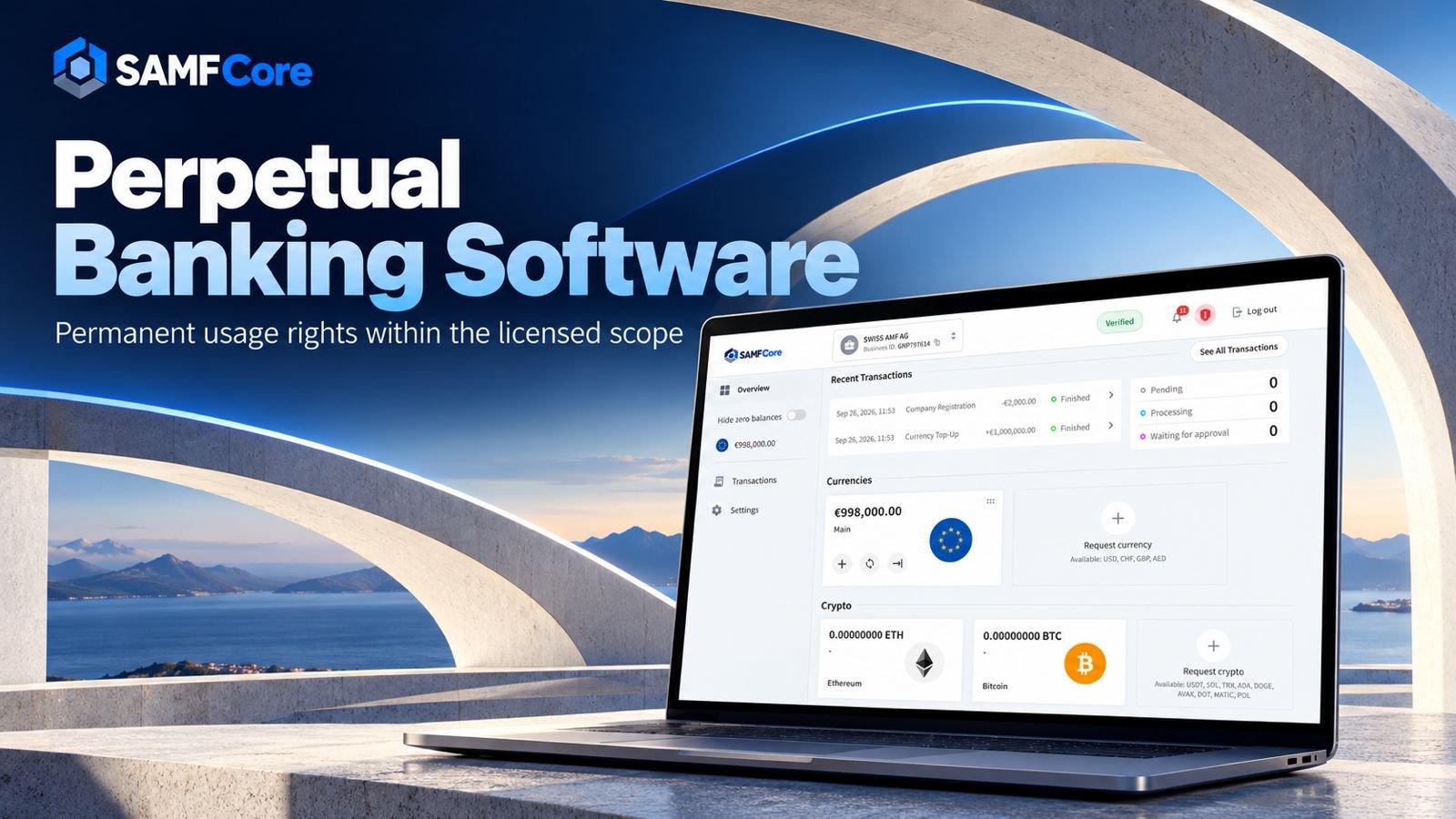
SAMFCore platform overview with Dr. Kassem Lahham — editorial illustration.
After nearly four decades working across international banking and financial markets, I have seen technology evolve from institution-specific infrastructure to increasingly modular financial ecosystems. My career began in 1987 and has included professional experience with Deutsche Bank, UBS, Pictet & Cie and the Emirates NBD Group, as well as work across European and Middle Eastern financial centres. Working fluently in English, German, French and Arabic has given me a close view of how financial institutions, their customers and their regulators approach technology differently across markets.
This experience has shaped one conviction: financial software should be judged not by the sophistication of its presentation alone, but by the control, flexibility and lasting operational value it offers the institution. SAMFCore, developed and commercialised by Swiss AMF AG, came to my attention because it combines a broad financial-services interface with a licensing model that merits serious attention from payment institutions, fintech operators and digital-asset businesses.
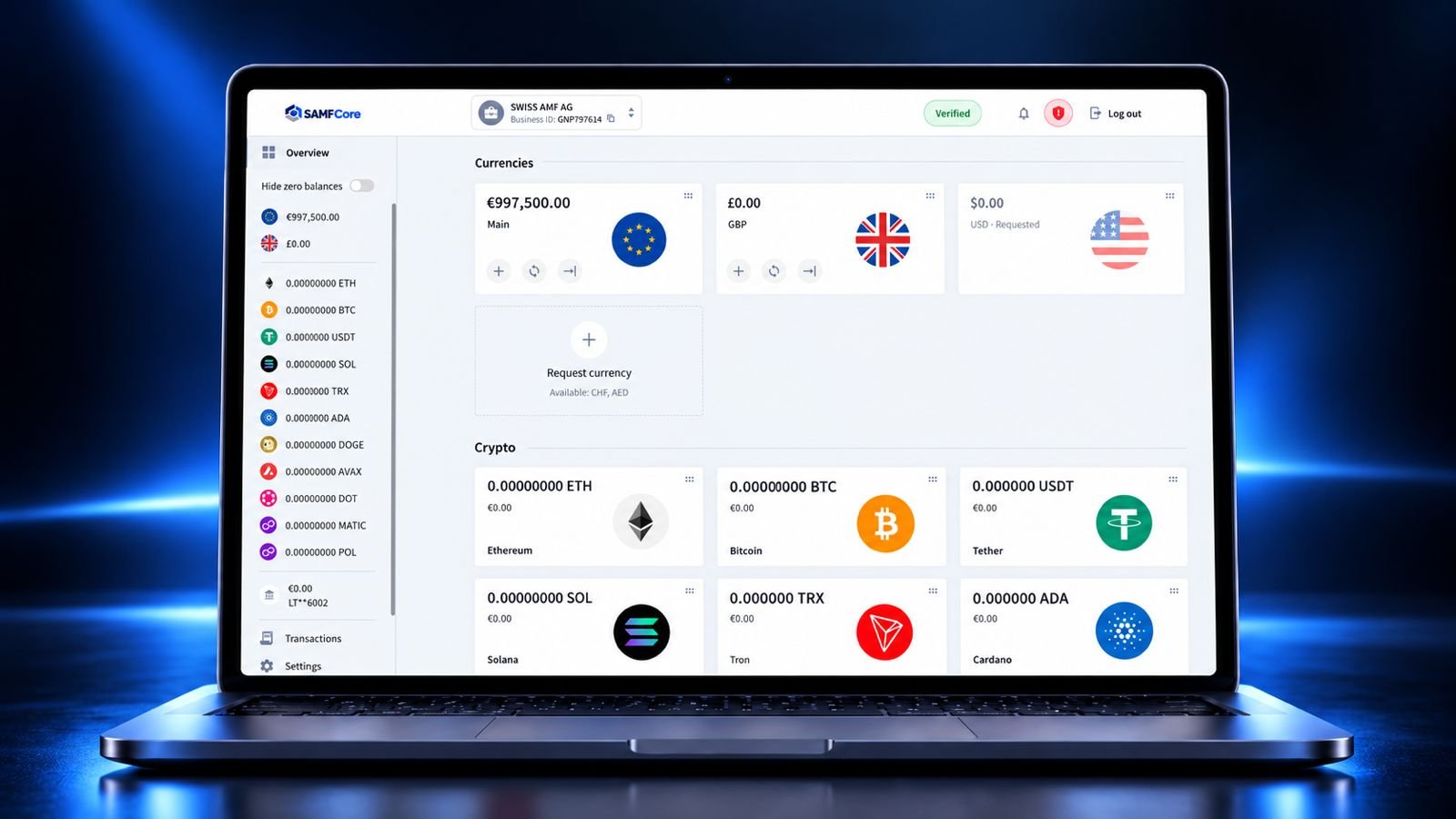
SAMFCore multi-currency and digital-asset interface — supplied product visual.
The executive perspective
SAMFCore is designed to bring accounts, payments, card workflows, digital assets, customer administration and compliance-related functions into a connected operating environment. Its proposition is particularly relevant to firms weighing fragmented software stacks against a more unified platform. The commercial question is equally important: what does an organisation retain after years of licensing expenditure, implementation work and operational growth?
My assessment of SAMFCore is strongly favourable. Having personally explored its customer-facing and administrative environments, I was particularly impressed by the combination of extensive financial functionality, intuitive design and an unusually attractive licensing structure. For financial-services businesses seeking to reduce technology costs while gaining greater control over their infrastructure, SAMFCore represents a particularly compelling proposition. These strengths do not remove the need for deployment-specific technical, security, regulatory and financial due diligence.
1. What Is SAMFCore?
SAMFCore is a modular financial-services software platform intended for fintech companies, electronic money institutions (EMIs), payment-service providers, digital-asset businesses, neobanks and other financial-services operators.
Its documented capabilities encompass customer onboarding, individual and corporate accounts, internal balance management, transaction processing, payments, physical and virtual card workflows, cryptocurrency, fiat-to-crypto exchange, foreign exchange, compliance processes and customer administration.
The system includes customer-facing interfaces, administrative and back-office applications, application services, databases, APIs and integrations with external financial-service providers.
Importantly, SAMFCore contains internal balance-management and transaction-accounting capabilities. It can record transactions, maintain customer balances and process transfers between accounts within the platform.
This distinguishes it from software products that function primarily as presentation layers over external service providers.
However, SAMFCore is not presented as a complete authoritative core banking ledger. External banking, payment settlement, custody and regulated financial services continue to depend on appropriate third-party infrastructure.
That distinction is important when evaluating it against traditional core banking systems.
SAMFCore's greatest functional appeal is the ability to bring a broad range of financial-services workflows into a common operating environment, reducing the need to develop and maintain numerous separate applications.
What makes this particularly impressive is the breadth of functionality available within a single environment. Rather than requiring operators to assemble separate customer-account, payment, card, cryptocurrency and administrative systems, SAMFCore provides an integrated foundation capable of supporting multiple financial products under one brand. For operators seeking to expand their services, this can represent a substantial advantage in implementation efficiency, customer experience and long-term operational management.
For an EMI or digital-asset business seeking to provide accounts, payments, cards and crypto-related services through one branded platform, this is a substantial practical advantage.
2. User Experience and Ease of Use
One of SAMFCore's most appealing characteristics is the simplicity and coherence of its user experience.
Financial-services platforms can become cumbersome as functionality expands. Accounts, payments, cards, digital assets, compliance procedures and administrative tasks often involve separate systems, inconsistent navigation and complicated operational workflows.
SAMFCore takes an appealingly straightforward approach.
Hands-on exploration of SAMFCore's sandbox environment revealed clean, modern customer-facing interfaces, logically organised financial functions and an administrative environment that brings related operational activities together in one consolidated view.
I was able to explore the functionality and workflows of both the customer-facing and administrative panels. This provided a direct opportunity to assess how the platform presents financial information, organises its principal functions and supports navigation between related activities.
Rather than making its considerable functional breadth visually overwhelming, the platform presents a relatively straightforward and accessible interface.
This matters for two distinct groups.
For end customers, simplicity influences how easily they navigate accounts, view balances, initiate transfers, access payment information and manage financial products.
For financial-services operators, coherent administration and clearly organised workflows can reduce unnecessary operational complexity, particularly where employees must handle customer onboarding, transactions, compliance reviews and account administration.
The platform's integrated design is also commercially relevant. A business seeking to offer several financial products does not necessarily want customers moving between unrelated interfaces or employees working across numerous disconnected applications.
SAMFCore demonstrates how a broad range of financial-services capabilities can be presented through a consistent software environment without making the underlying complexity equally visible to users.
That is an important characteristic of good financial software: sophisticated functionality should not require a correspondingly complicated experience.
The hands-on sandbox evaluation supports a favourable conclusion regarding the platform's interface design, navigation and everyday usability. However, it does not establish performance under full production workloads, accessibility compliance or long-term operational reliability.
Assessment: SAMFCore makes a notably favourable impression from a usability perspective. Its combination of clean design, coherent navigation and substantial financial functionality is a meaningful product strength that deserves attention alongside its commercial advantages.
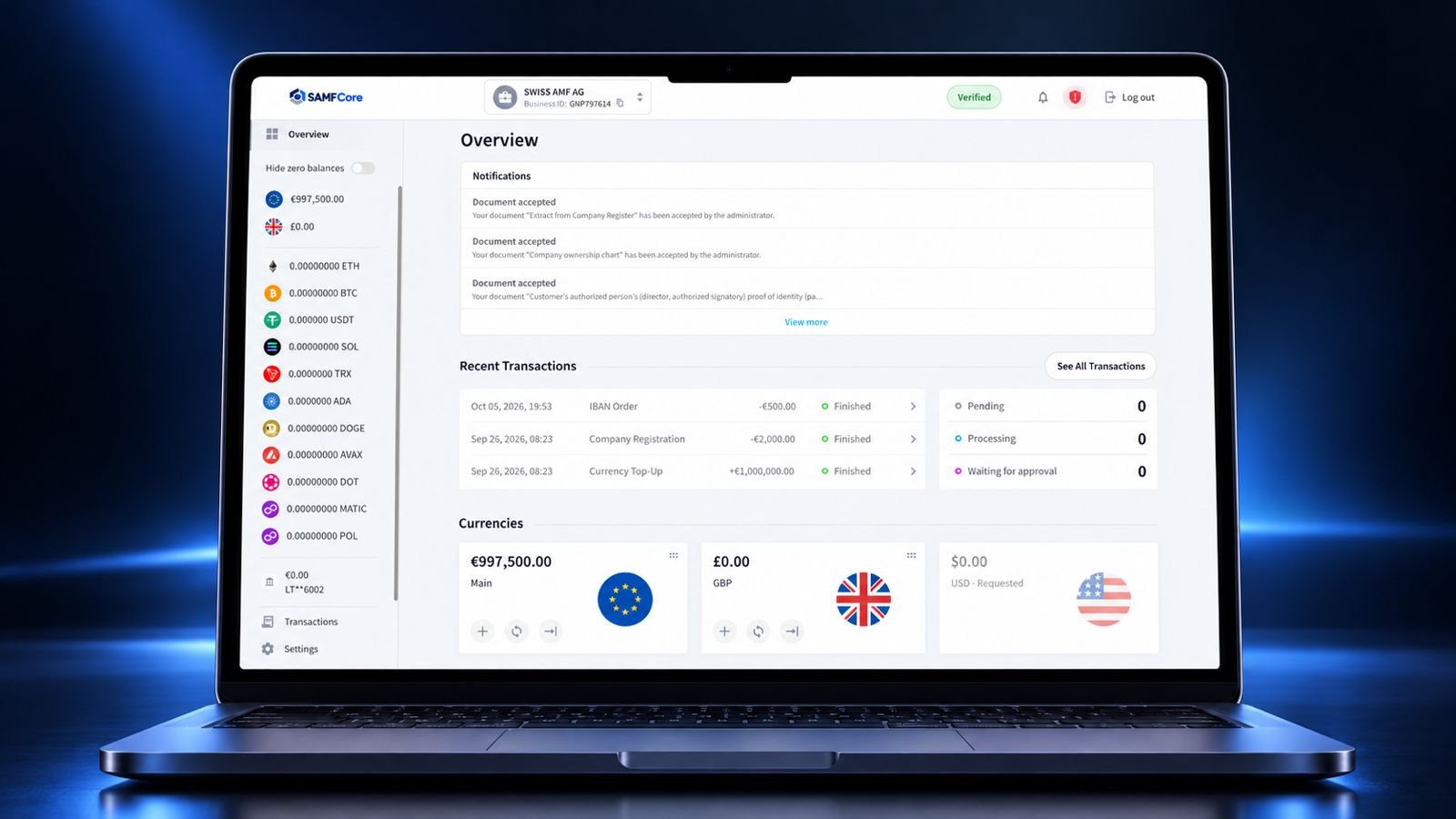
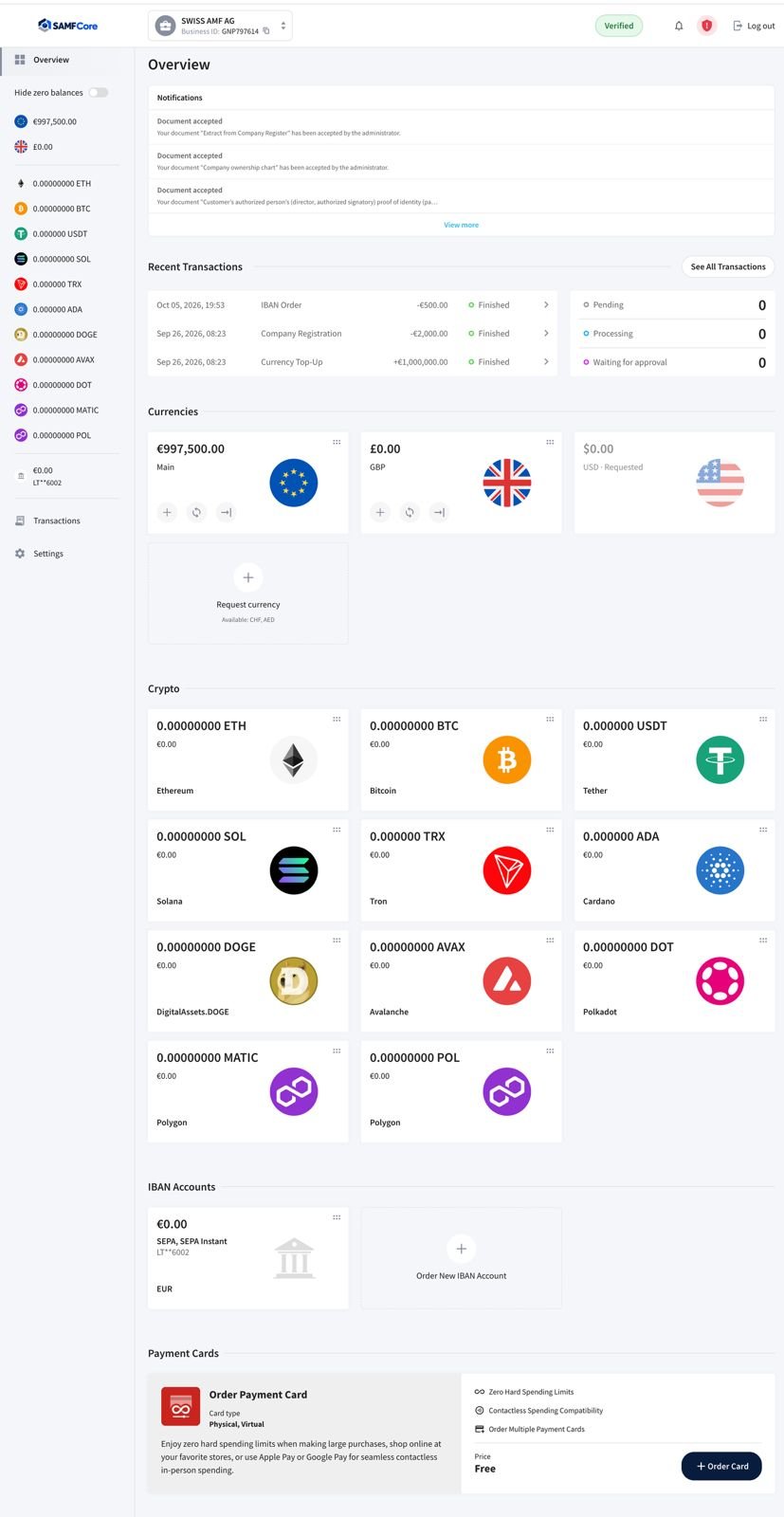
A consolidated customer view showing balances, currencies and digital assets.
3. An Unusually Attractive Licensing Structure
SAMFCore's licensing model is arguably its strongest commercial differentiator.
The company publishes four primary packages:
Published SAMFCore Licence Prices — October 2026
Package
Indicative published price
Annual licence
€80,000 / year
Perpetual licence
€325,000 one-time
Perpetual + full source code
From €620,000
Enterprise Global
€790,000 one-time
Pricing is reproduced from the supplied review dated 22 October 2026 and must be confirmed directly with the provider; scope, integration, infrastructure, support and third-party charges are separate.
The perpetual packages grant continuing contractual software usage rights within the licensed scope without requiring annual SAMFCore software licence renewals.
Full Source Code packages additionally permit qualifying customers to access, maintain, modify and further develop their licensed software using internal personnel or appointed developers.
The Enterprise Global package combines perpetual rights, Full Source Code, worldwide geographic usage rights and unlimited white-label brands for one licensed legal entity. It also includes Progressive Cutover Migration within the agreed implementation scope.
These are meaningful distinctions for businesses intending to operate financial-services infrastructure over many years.
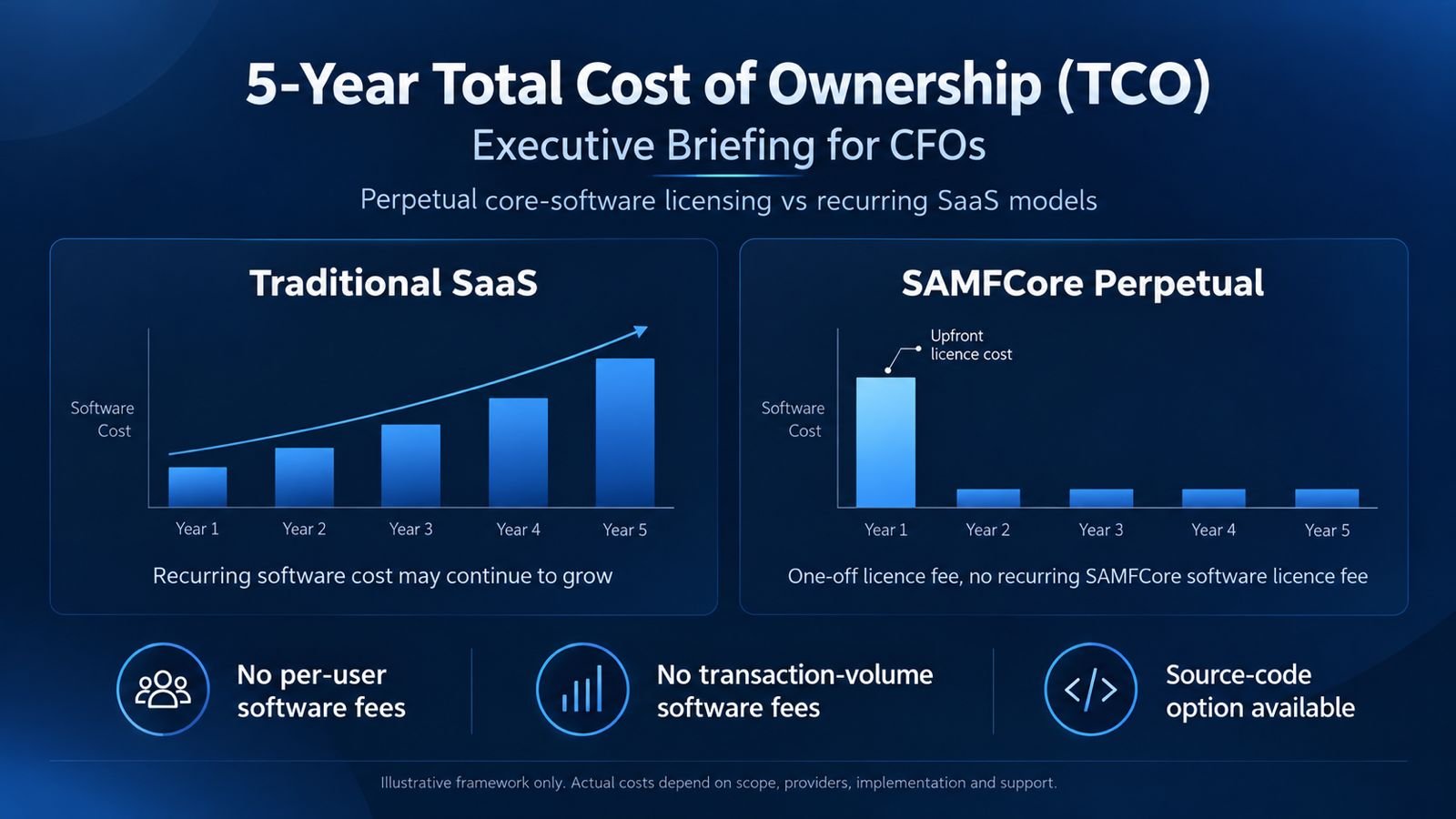
A conventional subscription may reduce initial expenditure, but long-term software costs can become substantial. Perpetual licensing allows purchasers to make a different financial decision: accept greater initial capital expenditure in exchange for continuing usage rights without recurring licence renewals.
The significance of this approach should not be underestimated. Financial-services businesses commonly invest substantial resources in implementing, integrating and adapting their software platforms. With perpetual licensing, that investment can support infrastructure the business has continuing contractual rights to use, rather than infrastructure whose continued availability depends on recurring software licence renewals. For established operators, this represents an important strategic distinction.
The model will not suit every purchaser. A startup conserving capital may prefer a managed SaaS arrangement, even at a higher cumulative cost.
For a sufficiently funded and established financial-services business, however, the ability to acquire continuing software rights can be particularly attractive.
4. No Transaction-Based Software Fees: A Potentially Major Financial Advantage
An aspect of SAMFCore's pricing that deserves particular attention is its explicit absence of per-customer and per-transaction software charges.
Under its published licensing terms, SAMFCore does not impose software fees based on the number of end customers or customer transactions and does not take a percentage of transaction revenue.
This applies across its annual and perpetual licence packages.
The significance becomes clearer when considering the economics of a growing payment or financial-services business.
A software platform charging even a small amount per transaction can become increasingly expensive as activity rises.
For illustration, a hypothetical platform charging €0.02 per transaction would generate €200,000 in annual software transaction charges at 10 million transactions. At 50 million transactions, the charge would reach €1 million annually.
These figures are illustrative, not an assertion that SAMFCore's competitors generally charge such fees.
SAMFCore's published model avoids this particular category of software cost.
External banking, payment-processing, card, custody, infrastructure and other provider fees remain payable separately. Implementation and maintenance can also carry additional costs.
Consequently, the absence of transaction-based software fees does not mean that financial transactions themselves are cost-free.
Nevertheless, the distinction is commercially significant.
For high-volume financial-services operators, the financial implications can be considerable. By eliminating per-customer and per-transaction SAMFCore software charges, the platform allows transaction volumes and customer numbers to grow without corresponding increases in these categories of software expenditure. Over five or ten years, this can create a substantial economic advantage compared with software arrangements that impose recurring usage-based charges. External provider, implementation, hosting and support costs remain separate.
Equally important, predictable software licensing costs can simplify financial planning and allow operators to retain more of the economics of customer growth.
Illustrative five-year licensing cost framework; actual project economics will differ.
5. Full Source Code and Long-Term Technical Independence
Source-code access is increasingly relevant to financial-services companies concerned about vendor dependency.
SAMFCore offers qualifying purchasers contractual rights to inspect, modify, maintain and further develop the licensed software.
Customers can use their own engineers or independently appointed development providers rather than being contractually required to retain Swiss AMF AG for all future technical work.
The platform's licensing model also permits customer-controlled deployment and independently selected infrastructure providers.
This provides several potential advantages: control over development priorities, freedom to implement additional integrations, flexibility in maintenance arrangements and the ability to manage infrastructure according to internal security and regulatory requirements.
An important qualification is that a Full Source Code licence does not transfer ownership of SAMFCore's underlying intellectual property. Nor does it automatically confer unrestricted rights to resell, sublicense or operate unrelated third-party businesses on the software.
The distinction between ownership of intellectual property and extensive contractual usage rights is fundamental.
Nonetheless, within the licensed scope, SAMFCore's approach can deliver substantial long-term technical independence.
Actual independence will depend on the completeness of delivered source code, build materials, documentation, third-party dependencies and the customer's technical capabilities. Those matters should be verified during technical due diligence.
6. Independent Swiss Legal Opinion: An Important Assurance
A notable feature of SAMFCore's documentation is an executed independent Swiss legal opinion addressing the platform's legal and commercial foundations.
The opinion examines Swiss AMF AG's intellectual-property ownership and commercialisation rights, perpetual software licensing, Full Source Code licensing, customer-controlled deployment, independent software maintenance and development, and customer data portability.
It also addresses the platform's Swiss development history and the distinction between software commercialisation and regulated financial activities.
According to the review materials, the opinion concludes that Swiss AMF AG possesses intellectual-property ownership rights and contractual authority to commercialise SAMFCore, including granting perpetual and Full Source Code licensing rights.
For institutional buyers, these are important questions.
Purchasing a perpetual licence or extensive source-code rights involves more than evaluating the quality of the technology. The purchaser must also be confident that the licensor has the authority to grant the rights being offered.
An executed legal opinion from independent Swiss counsel provides an additional layer of professional assurance concerning that legal framework.
It does not eliminate the need to examine the actual licence agreement, nor does it amount to an independent technical audit, cybersecurity certification or software valuation.
Its value lies in addressing legal matters that might otherwise present uncertainty in a substantial software acquisition.
This is a meaningful strength in SAMFCore's overall proposition.
7. Swiss Development and Established Operational History
SAMFCore's development history is another positive distinguishing characteristic.
The platform originated from software development undertaken in Switzerland beginning in 2018, in cooperation with Swiss AMF AG.
Its principal financial-services functionality was developed by 2021, followed by continued maintenance, refinement and further development.
A historical developer-provided platform evaluation dated January 2024 recorded an estimated 7,180 developer-days and an associated estimated development value of €11.488 million.
Those figures are historical development estimates, not audited expenditure or an independent determination of market value. Subsequent development work is not reflected in them.
They nevertheless provide context regarding the estimated scale of the underlying software-development effort.
The platform has continued to evolve since that evaluation, including further maintenance, customisation and development through specialist providers.
Its documented history and operational deployments are relevant to purchasers assessing whether the software is an established product or a relatively new technology proposition.
They should not, however, be confused with independently audited uptime, transaction-volume or scalability records.
The available evidence supports the conclusion that SAMFCore is an established software platform with substantial development history, rather than a newly conceived or purely conceptual product.
8. Performance and Scalability: Tested Under Substantial Loads
Historical performance testing provides compelling evidence of the platform's technical maturity and scalability. During extensive load-testing exercises in 2021, involving the technical team of a prospective Swiss corporate purchaser, the cryptocurrency exchange infrastructure was tested with approximately 40,000 simulated concurrent users generating some 1.2 million requests per minute, equivalent to approximately 20,000 requests per second. Subsequent exercises reportedly simulated up to approximately 192,000 concurrent users. These are impressive historical testing figures, particularly given the prospective purchaser's direct involvement in evaluating the platform's capabilities and limitations.
These are notable reported figures, particularly considering that the testing took place in 2021. Equally significant is the involvement of a prospective purchaser's technical team, which had a direct commercial interest in identifying weaknesses and evaluating whether the software could meet demanding operational requirements.
The exercises demonstrate that the platform's cryptocurrency infrastructure was subjected to substantial simulated workloads and provide encouraging evidence of its ability to accommodate high levels of activity. For financial-services operators concerned about transaction volumes, customer growth and periods of exceptional demand, this historical testing is a meaningful indicator of the underlying technology's scalability potential.
There are, however, important distinctions. Requests per second are not equivalent to successfully completed trades per second, and simulated concurrent users are not necessarily equivalent to an identical number of continuously active trading customers. Furthermore, the tests relate to the cryptocurrency exchange infrastructure as configured in 2021, rather than every component of SAMFCore's current platform.
9. Provider Independence and Deployment Flexibility
SAMFCore is designed to integrate with banking institutions, payment-service providers, card issuers, digital-asset custodians, cryptocurrency exchanges, identity-verification providers and related technology services.
The operator can establish its own relationships with appropriate providers and select infrastructure arrangements suited to its business.
This can be advantageous when operating across different jurisdictions or adapting to changing commercial relationships.
It also supports a business model in which the software supplier and the regulated financial-service providers remain distinct.
However, provider independence should not be interpreted as universal plug-and-play compatibility.
A new banking or payment integration may require bespoke development, commercial onboarding, certification or approval. The feasibility and cost of individual integrations must be assessed separately.
SAMFCore's flexibility is therefore best understood as an architectural and contractual advantage, rather than a guarantee that every provider is immediately available.
For experienced financial-services operators with existing banking and processing relationships, this model may be particularly suitable.
10. Migration: Addressing the Difficulty of Replacing Existing Software
SAMFCore offers a Progressive Cutover Migration approach for organisations considering replacement of an existing platform.
The published methodology addresses migration planning, customer and transaction data, existing provider relationships, integration transition, staged user migration and eventual cutover.
Rather than assuming every customer and operational process must move simultaneously, the approach contemplates progressive migration where the relevant systems and requirements permit it.
This is important because migration risk can be a decisive factor when institutions evaluate replacement technology.
Existing financial-services businesses may have extensive customer records, long-standing payment-provider relationships, operational reporting requirements and compliance processes that cannot simply be interrupted.
A structured migration approach makes SAMFCore more relevant to established businesses than a product focused exclusively on new launches.
Prospective purchasers should nevertheless obtain a detailed migration plan addressing data reconciliation, testing, fallback arrangements, provider dependencies and acceptance criteria.
The methodology is commercially attractive, although independently documented results from completed migrations would provide stronger evidence of execution capability.
11. Competitive Position
SAMFCore operates in a competitive market that includes established financial-services technology providers such as Crassula, SDK.finance, Velmie and Baseella.
These platforms offer overlapping functionality, and several provide source-code access, perpetual licensing or flexible deployment arrangements. SAMFCore is therefore not unique in offering individual features of this kind.
What distinguishes SAMFCore is the combination of broad financial-services functionality, an elegant and intuitive user experience, transparent published pricing, optional Full Source Code, customer-controlled deployment, independent maintenance arrangements and the absence of per-customer or per-transaction software fees and revenue sharing.
A particularly appealing aspect of the platform is the simplicity of its design. Despite supporting complex financial operations, SAMFCore presents its functionality through clean, well-organised customer and administrative interfaces. Hands-on exploration of the sandbox environment supports the impression of a platform designed around practical everyday usability rather than unnecessary technical complexity.
Crassula offers an established white-label platform and integration ecosystem, SDK.finance provides sophisticated transaction-processing infrastructure and source-code licensing, Velmie supports extensive customisation, and Baseella offers accounting-oriented capabilities that may appeal to more traditional banking institutions requiring a comprehensive general ledger.
Against these alternatives, SAMFCore's appeal is especially strong for businesses seeking to combine accounts, payments, cards, digital assets and compliance workflows in a coherent, accessible operating environment, while retaining substantial control over their software costs and technical arrangements.
Its commercial advantages may become particularly significant for operators with large customer bases or substantial transaction volumes, especially when compared with software contracts imposing usage-based charges.
The appropriate choice ultimately depends on functional requirements, ease of implementation, user experience, integration requirements and total cost of ownership. In my assessment, SAMFCore distinguishes itself through an unusually attractive combination of extensive financial-services functionality, intuitive user experience, perpetual licensing, optional Full Source Code, infrastructure independence and predictable software costs. While competing platforms possess their own strengths, SAMFCore’s combination of these characteristics makes it one of the most compelling propositions I have encountered for financial-services operators seeking greater technological and commercial independence.
Extended platform view illustrating account, digital-asset, IBAN and card-related modules.
12. Security, Compliance and Technical Due Diligence
SAMFCore's published materials describe administrative controls, permissions, authentication, compliance workflows, auditability and customer-controlled deployment options.
These are relevant capabilities for financial-services businesses, although the specific security measures and responsibilities will depend on the deployment.
An institutional purchaser should evaluate the source-code architecture, vulnerability management, access controls, data protection, infrastructure configuration, resilience and integration security.
Independent penetration testing, security assessments and operational evidence would be relevant to a final procurement decision.
There is also a regulatory distinction worth maintaining.
SAMFCore is software. Purchasing a licence does not itself confer banking, payment, electronic-money or digital-asset regulatory authorisation.
The operator remains responsible for the permissions and compliance arrangements applicable to its activities.
This is consistent with the executed Swiss legal opinion's distinction between software commercialisation and regulated financial services.
13. Principal Limitations
The assessment identifies four remaining areas in which stronger independent evidence would further improve SAMFCore's position.
First, although historical load-testing records demonstrate substantial performance and scalability testing, publicly available, independently verified benchmarks of SAMFCore's current production performance remain limited. Updated evidence of transaction throughput, operational availability and sustained high-volume processing would provide additional assurance to technically sophisticated buyers.
Second, Switzerland is known worldwide for its longstanding tradition of client privacy and confidentiality, and this discretion has always been one of the distinguishing strengths of its financial-services industry. But more attributable public-facing customer references and implementation case studies for SAMFCore would help establish real-world outcomes across different customer types.
Third, independent technical and security validation would provide assurance beyond product documentation and legal analysis.
Fourth, buyers should verify the completeness and reproducibility of source-code or Object Code deliverables, existing integrations and the scope of contractual independence in their particular licence.
These are significant procurement considerations, but they do not negate the strengths of the documented offering.
They establish the difference between evaluating a compelling software proposition and confirming that it will perform satisfactorily in a specific institutional environment.
14. Which Buyers Should Consider SAMFCore?
SAMFCore is especially well suited to established fintechs, EMIs, payment companies, digital-asset businesses and neobank operators seeking an integrated financial-services environment.
The proposition is strongest where the prospective purchaser values a combination of broad financial functionality, intuitive software design, predictable licensing expenditure, infrastructure control and freedom to appoint its own developers.
It may also appeal to financial-services businesses considering replacement of fragmented software arrangements or an existing platform with restrictive commercial terms.
By contrast, an early-stage business with limited initial capital may find a conventional managed SaaS offering more practical.
Institutions requiring a comprehensive traditional core banking ledger should conduct a particularly careful accounting and transaction-processing gap analysis.
The strongest fit is therefore not universal. It is concentrated among organisations for which usability, licensing flexibility and long-term operational independence are strategic priorities.
My concluding assessment
Having examined SAMFCore’s functionality, personally explored its customer and administrative interfaces, and considered its technical history, licensing structure and commercial positioning, I regard it as an exceptionally compelling financial-services software proposition. Its combination of extensive functionality, accessible design, technological flexibility and favourable long-term economics distinguishes it within a highly competitive market.
Its strengths extend beyond its extensive feature list and favourable licensing arrangements.
The platform brings together substantial financial-services functionality, a clean and intuitive user experience, established Swiss development history, perpetual licensing, configurable commercial rights, customer-controlled infrastructure, independent development options and an explicit policy of no transaction-based SAMFCore software fees or revenue sharing.
The executed independent Swiss legal opinion adds meaningful assurance concerning the intellectual-property and contractual framework behind those rights.
These characteristics are particularly relevant for institutions evaluating technology over a five- or ten-year horizon, rather than concentrating exclusively on initial implementation cost.
Competitors such as Crassula, SDK.finance, Velmie and Baseella have genuine strengths, and some offer comparable perpetual or source-code arrangements. SAMFCore's appeal lies in how its capabilities, ease of use and commercial freedoms are combined, packaged and priced.
The principal outstanding questions concern independently demonstrated production performance and implementation outcomes rather than an obvious weakness in the documented commercial proposition or observed sandbox experience.
For an established fintech, EMI, payment company or digital-asset operator seeking sophisticated financial-services functionality without unnecessary software complexity or long-term dependence on a single technology vendor, SAMFCore belongs on a serious procurement shortlist.
For established fintech companies, electronic money institutions, payment-service providers and digital-asset businesses, SAMFCore deserves serious consideration as a strategic technology investment. Its combination of sophisticated functionality, intuitive design, perpetual licensing, optional Full Source Code and freedom from transaction-based software fees creates a proposition that is difficult to overlook.
In my professional assessment, SAMFCore represents one of the more attractive financial-services software offerings available to organisations seeking to combine operational sophistication with long-term technological independence and financial predictability. I would strongly encourage institutions evaluating new financial-services infrastructure, or considering replacement of an existing platform, to examine SAMFCore firsthand.
That is a strong conclusion, but one grounded in the documented offering and hands-on sandbox assessment—not an assumption of technical superiority over every competitor.
Methodology, editorial perspective and disclosure
This feature draws on hands-on examination of SAMFCore's platform sandbox environment, analysis of publicly available product, pricing, licensing and technical materials, consideration of its executed independent Swiss legal opinion, and selected publicly available information from competing vendors.
I was granted hands-on access to SAMFCore's sandbox environment and independently explored the functionality, navigation and workflows of both the customer-facing and administrative panels. This provided a direct basis for assessing the platform's interface design, ease of use, functional integration and overall user experience.
While no source-code audit, penetration test, production-performance benchmark or formal usability study was conducted, the review's favourable conclusions regarding usability are based on firsthand interaction with the software rather than solely on product demonstrations or vendor-provided materials.
The historical performance figures discussed in this review are drawn from contemporaneous 2021 technical correspondence documenting load-testing exercises involving external specialists. I did not independently reproduce these tests or verify their results through original benchmarking data.
The review distinguishes documented contractual rights and disclosed product capabilities from independently tested engineering performance.
The referenced Swiss legal opinion addresses legal rights and contractual arrangements, not software security or technical-performance certification.
One of the advantages of my perspective on SAMFCore is that it extends well beyond simply examining the software in a sandbox environment or review of the technical, commercial, and legal documents. I have had business relationships with Swiss AMF AG, the company behind SAMFCore, as well as close professional relationships with Swiss financial-services companies that actually use the platform in their operations. These relationships have given me valuable firsthand insight into the platform's real-world commercial applications and the practical requirements of financial-services operators. Importantly, I am also familiar with how these companies themselves regard SAMFCore, and their positive feedback has added a valuable real-world dimension to my own assessment. These professional relationships, practical experiences and customer perspectives have helped inform my assessment, and the opinions and conclusions expressed are entirely my own.
Product specifications, prices and contractual terms may change. Final procurement decisions should be based on current vendor proposals, signed agreements and project-specific technical due diligence.
Editorial note: This article is intended for publication across financial-services and technology media. It presents a positive professional assessment, not an assurance of performance, a regulatory endorsement or a substitute for independent procurement due diligence. Product images are supplied visuals and may illustrate sandbox or example data.